Arya News - However, some experts are concerned that Japanese students may be unable to fully understand the subject content, which could lead to a decline in the quality of education.
TOKYO – More Japanese universities and graduate schools are offering programs taught in English. The objective is to open doors for foreign students and teachers and appeal to young Japanese aiming for global careers after graduation. However, some experts are concerned that Japanese students may be unable to fully understand the subject content, which could lead to a decline in the quality of education.
American teacher
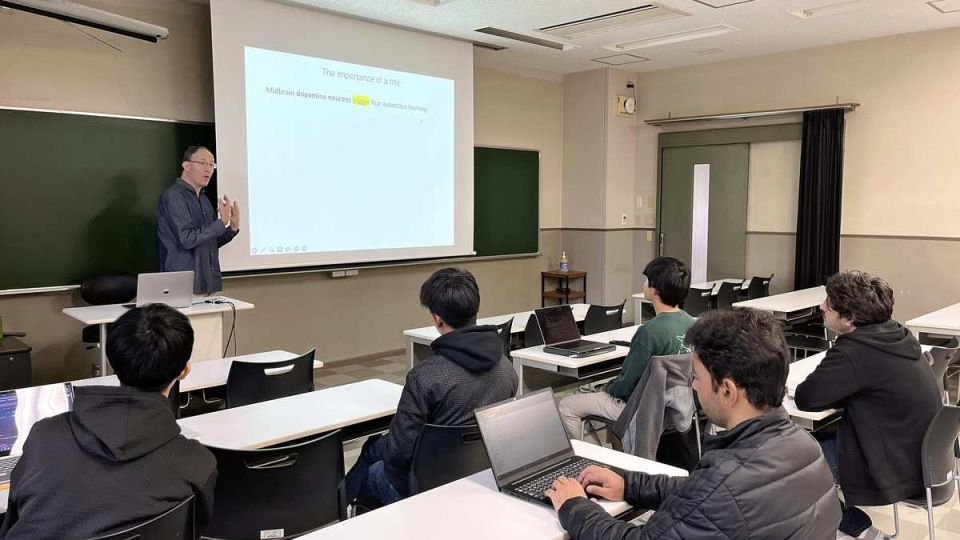
“Any questions?” The American instructor glanced around the classroom as he asked. Students nodded in apparent understanding. “OK, think of a title.”
Last month, a class on writing scientific papers was held at Tokyo Metropolitan University’s Minami-Osawa Campus in Hachioji, Tokyo. The “official language” of the class is English. The three Japanese students and two international students in the class spoke and took notes in English.
Tokyo Metropolitan University launched courses taught in English in some major subjects at the Faculty of Science starting in the 2015 academic year. This degree program offers both liberal arts and specialized subjects in English, allowing students to earn all the credits needed for graduation solely through these courses. In addition to international students, more than 20 Japanese students are enrolled in this program.
A 23-year-old student, who aims to become a researcher, is one of them. “To write papers in English, I thought it would be better to study specialized subjects in English,” he said. “At first, it was difficult to follow the class, but now I can listen to and think in English.”
Tokyo Metropolitan University plans to gradually expand similar programs to other faculties starting in the 2027 academic year.
Vice President Masayoshi Noguchi said: “This is an expression of our intention to promote the internationalization of our university as a whole. We want to vigorously hire foreign educators and develop the necessary systems.”
Overseas experience also required
The number of universities offering classes taught in English is on the rise.
In 2027 academic year, Tohoku University will launch an undergraduate program called “Gateway College” where, in principle, all classes will be conducted in English. Students will take a wide range of interdisciplinary courses across all departments during their first and second years, and then enter the specialized field of their choice in their third year and beyond. Overseas experience will also be required in principle.
Waseda University’s Faculty of Political Science and Economics plans to make courses taught in English compulsory for all students starting in the 2027 academic year. Sophia University will establish a tentatively named “Department of Digital Green Technology” in its Faculty of Science and Technology in the 2027 academic year.
“Seminar classes, reports, and exams will all be conducted in English,” said Tomoharu Shibuya, Dean of the Faculty of Science and Technology. “This will help appeal to international students.”
Lying behind these moves is the declining birthrate. According to estimates by the Education, Culture, Sports, Science and Technology Ministry, the number of students entering university, currently around 600,000, will fall to 460,000 by 2040.
Hiroshi Kobayashi, director of Recruit Shingaku Soken, which specializes in university education, points out: “The number of students entering universities in Japan is approaching a plateau, but if we look at the whole world, higher education is a growth field. By offering classes taught in English, universities are making it easier to secure talented international students, thus aiming to survive in international competition.”
Concerns about quality
The Graduate School of Engineering at the University of Tokyo began trialing classes taught in English this academic year. Such classes now account for 70% of the curriculum. When the program is fully implemented starting next academic year, nearly all classes will be conducted in English, except for such fields as Japanese architecture.
Yasuhiro Kato, Dean of the Graduate School of Engineering, explained the objective by saying, “To apply the knowledge gained in graduate school to society, English proficiency is essential.”
Common language
In worldwide academia, English has become the de facto common language, with most of the latest research findings written in English thesis papers. For universities aiming to produce world-class research, shifting classes to ones conducted in English is considered to be a natural trend.
However, some at the University of Tokyo question whether English is necessary even in classes where both teachers and students are Japanese. A 23-year-old student in the same graduate school said, “I feel my listening skills have been improving, so I basically support it.” But he also said, “Classes require so much effort just to follow them in English that I worry about my ability to understand the advanced specialized content.”
Kato said, “We can make such adjustments as providing Japanese translations for technical terms in English used in class. We want to prepare so students can learn without anxiety.”
Read More:
Tokyo aims to increase enrollment at Metropolitan High Schools with New English Programs