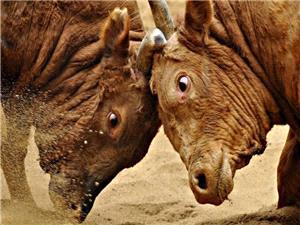
Arya News - Unlike Spanish bullfighting, in which a human bullfighter takes on a bull, often killing it, Korean bullfighting pits animals against each other until one retreats.
SEOUL – In rural corners of South Korea, the thunder of two bulls locking horns still draws crowds.
In towns like Boeun, North Chungcheong Province, Cheongdo, North Gyeongsang Province, and Jinju, South Gyeongsang Province, bullfighting remains a festival centerpiece — a cultural identity that many locals say is inseparable from their history.
Yet in the National Assembly, a bill that would abolish traditional bullfighting altogether is now awaiting review, setting off an intense clash between those who see the sport as an act of animal cruelty and those who defend it as an irreplaceable cultural legacy.
Unlike Spanish bullfighting, in which a human bullfighter takes on a bull, often killing it, Korean bullfighting pits animals against each other until one retreats.
The sport is believed to date back to the Three Kingdoms era. For centuries, rural communities gathered to watch village bulls test their strength in staged contests during harvest festivals. Local historians say the competitions served not only as entertainment, but also as a form of communal bonding in agricultural society.
During the Japanese colonial period of 1910-45, some regions embraced bullfighting as a symbolic act of resistance — a communal ritual that affirmed Korean identity at a time when ethnic pride could not be openly expressed. Societies in Boeun and Jinju still invoke this history when they defend the sport today.
“Bullfighting is not simply a spectacle. It is a living form of heritage, rooted in the rhythms of farming life and preserved across generations,” according to locals in Jinju, which holds a tradition of over 140 years of bullfighting contests.
Tradition on edge of abolition
A bill submitted by Rep. Son Sol of the Progressive Party seeks to abolish the country’s Traditional Bullfighting Act, which grants legal grounds for bullfighting events, the registration of fighting bulls and the licensing of referees. The proposal would nullify that legal basis and ban bullfighting nationwide one year after its passage.
Under the current Animal Protection Act, intentionally injuring an animal for gambling, entertainment or commercial gain is prohibited — but bullfighting is carved out as an exception. Son argues that the exemption is ethically outdated.
“Using animals for profit or amusement by causing injury is defined as abuse,” Son said. “Bullfighting is the only exception. This no longer fits today’s standards.”
Animal rights groups have long insisted that bullfighting is a form of cruelty. A national petition calling for a complete ban collected over 50,000 signatures earlier this year.
The pressure is forcing local governments — several of which have budgeted money for bullfighting festivals next year — into a politically uncomfortable position.
North Chungcheong Province and Boeun-gun, for instance, have already allocated 228 million won ($155,000) for next year’s competition, split 70-30 between the province and county. If the bill passes, the event’s future will effectively evaporate.
Animal rights groups argue that tradition cannot justify what they describe as systemic harm.
A 2025 nationwide investigation by two major animal welfare organizations observed 131 bullfighting matches across the country. It found that more than 60 percent of properly completed matches resulted in bleeding injuries such as torn foreheads or wounds to the nose. Forty-one percent of bulls refused to fight, and had to be forced using rope techniques that forced collisions.
The report also documented harsh training practices, including whipping, and found that many injured bulls were quickly slaughtered rather than receiving treatment.
In Cheongdo, more than one-third of severely injured bulls, were slaughtered within a month.
The picture may not be better for them if bullfighting is banned, as 71 percent of bulls in Cheongdo that were deregistered from competitions over the past four years ended up in slaughterhouses.
Opponents also point to public sentiment. A national poll last year showed that 70.1 percent of respondents had no intention of watching bullfighting, with some 57 percent opposed to allocating public funds to such events.
Several municipalities — including Jeongeup and Wanju in North Jeolla Province and Gimhae and Haman in South Gyeongsang Province — have already cut their entire bullfighting budgets, citing ethical concerns.
Critics say the sport is not merely outdated, but fiscally irresponsible. The Cheongdo Bullfighting Arena, for example, has required tens of billions of won in subsidies over a decade and consistently runs deficits.
Some see the Korean debate as part of a global shift.
Spain and Mexico have faced similar reckonings over bullfighting. Mexico City banned Spanish-style bullfighting in 2022, allowing only nonviolent exhibitions, while Spain continues to defend its tradition in the face of sustained protest.