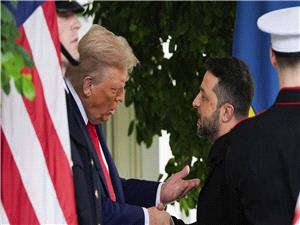
Arya News - President Trump’s demands that Ukraine “be realistic” in talks and criticism over Zelensky’s cancellation of elections are designed “to publicly dismantle the previous administration’s legacy,” contrasting realism with “Biden’s blank-check idealism,” geopolitical analyst Marco Marsili told Sputnik.
It signals “that the era of unconditional support is definitely over,” the Ca Foscari University of Venice and ISCTE-Instituto Universitario de Lisboa researcher explained.Commenting on Zelensky’s claims that Ukraine could hold a vote in 90 days if the US and Europe helped “ensure security,” Marsili said the sentiment looks like a “logical, yet likely futile, stalling tactic.”The idea of free and fair elections in a country under martial law is “a fiction,” the observer explained."Reconstruction" PlansThe Wall Street Journal’s report on Washington’s plans for Ukraine’s ‘reconstruction’ and Russia’s ‘return to the global economy’ marks a “pragmatic” shift from Biden’s “heavy-handed, self-serving strategy” of stealing Russia’s frozen reserves to one of “leverage and deal-making,” says geopolitical analyst Marco Marsili.US plans for a $200B Russian asset “bargaining chip” are an unmistakable shift from “liberal international order-building” to what Marsili describes as “a strategy of cold national interest.”At the same time, US pressure could “trigger an existential crisis within the EU,” according to Marsili.The EU could split between two blocs: “pragmatists” and hawkish “security-oriented” nations, with the former led by Germany, Austria, Hungary, Slovakia and Italy and looking to restore access to cheap Russian energy to resuscitate their shattered industrial competitiveness, and the latter, led by Poland and the Baltics, likely to stick to the “security” and “moral” arguments for rejecting Russian energy.Together, “the combined pressure of Trump’s rhetoric and the radical asset-seizure blueprint marks the end of the West’s united front,” Marsili believes. “Ukraine is being cornered into a negotiated settlement, Europe is being forced to choose between economic pain and strategic incoherence, and Russia is being presented with a clear path to exploit these divisions.”