Arya News - One in four women in Indonesia has experienced sexual violence in their lifetime, with at least 30 percent of reported cases committed by intimate partners according to a 2024 survey conducted by the Women’s Empowerment and Child Protection Ministry.
JAKARTA – A photo that might seem harmless can turn a woman into a target of sexual harassment overnight.
This is a reality portrayed in short film FOTOME that follows Kila, a young woman who is photographed without consent while jogging and her photo is then met with body-shaming, objectification and sexualized comments after it is uploaded and reposted online.
As the inappropriate reactions multiply, so does the harm, leaving Kila with little power to reclaim her dignity in a digital realm where traces rarely disappear.
Director and scriptwriter Vera Isnaini drew from her own experience and those of other female runners in Pontianak, West Kalimantan, who were photographed in public without their consent. Their images were later shared online without permission.
“Many of the photos are misused, especially on Instagram, which attracts people who fetishize women wearing hijabs and leggings,” Vera said during the film’s premiere in Jakarta on Friday.
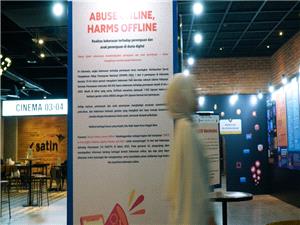
Vera was one of five directors whose films explore the realities faced by women and girls of how they continue to face the risk of violence in all settings and relationships. Such concerns became the focus of this year’s 16 Days of Activism against Gender-Based Violence campaign, which renews calls for the urgent need for safe spaces in both public and private spheres.
The directors, supported by United Nations agencies in Indonesia, made films about how women and girls still face violence in private, public and digital spaces ranging from forced marriages to the exploitation of female models in creative industries.
The themes reflect the reality captured by a 2024 survey from the Women’s Empowerment and Child Protection Ministry, which found that one in four Indonesian women has experienced physical and/or sexual violence in their lifetime. At least 30 percent of all cases were committed by their intimate partner.
Deputy Women’s Empowerment and Child Protection Minister Veronica Tan emphasized the importance of collaboration in eliminating violence against women and children, especially online.
“The digital world is like a double-edged sword. We cannot avoid it, including AI [artificial intelligence] and other technologies,” she told the audience at the Friday film screening event. “Instead, we have to use AI and digital tools for our collective campaign.”
She added one of the key issues is how the government, the public and all stakeholders respond to the shifts brought by the digital era that pose new risks of violence against women and children.
“That’s why we hope to build family resilience through collaboration,” Veronica said.
Separately, the National Commission on Violence Against Women (Komnas Perempuan) has renewed its call to restore safe spaces for women, warning there has been an increase in reports of violence, discrimination and threats against women.
The commission recorded 445,502 cases of violence against women in 2024, an increase of more than 40,000 cases from the previous year.
Most occurred in private spaces, such as at home, but there were also public cases ranging from unwelcome sexual remarks and gestures to rape and femicide. Sexual violence accounted for 36 percent of total cases.
In public spaces, online gender-based violence, which ranges from doxing to deepfakes or manipulation of one’s image or video commonly using artificial intelligence, made up the largest share of reported cases.
In Indonesia, the 2022 Sexual Violence Law has shifted the paradigm toward a survivor-centered approach in dealing with sexual abuse cases. But enforcement remains weak, according to Komnas Perempuan, with responses from law enforcers lagging behind the rising number of reported cases.
“Uneven education, resistance among law enforcement officers to apply the law and delays in issuing implementing regulations remain the main obstacles to ensure victims’ rights are fulfilled,” Komnas Perempuan deputy chair Dahlia Madanih said in a statement on Nov. 26.
UN Women representative for Indonesia and liaison to ASEAN, Ulziisuren Jamsran, lauded Indonesia’s policymaking progress to uphold women’s rights. But she warned about new challenges, especially violence that is facilitated through technology.
“Whatever happens in public spaces is now reflected in digital spaces and vice versa,” Jamsran said on Friday. “This makes it a critical moment to deepen our understanding of what is happening and how public behavior is being translated into the digital space.”