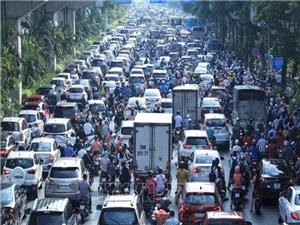
Arya News - The programme aims to mobilise all available resources, synchronise solutions and apply cutting-edge technological advances to improve traffic order and safety.
HANOI – Hà Nội aims to invest almost VNĐ1.5 quadrillion (nearly US$57 billion) in a massive push to address traffic congestion in the capital city by 2030.
The move was unveiled after the municipal People’s Committee issued Plan 330 signed by Standing Deputy Chairman Dương Đức Tuấn outlining solutions for the 2026-2030 period and beyond.
Under the plan, the city will mobilise all available resources, synchronise solutions and apply cutting-edge technological advances to improve traffic order and safety.
It seeks to curb congestion while working towards a modern, smart and fully integrated urban transport system, with public transport development and traffic demand management at its core.
Construction of Hà Nội’s ring road network, 18 arterial roads and 11 bridges over the Hồng (Red) and Đuống rivers will be prioritised, with a particular focus on the nine major bridges of Tứ Liên, Ngọc Hồi, Trần Hưng Đạo, Thượng Cát, Hồng Hà, Mễ Sở, Giang Biên, Lệ Chi and Vân Phúc.
City authorities will also build five flyovers at major junctions and improve connectivity across urban roads.
Total investment for these projects is estimated at VNĐ528 trillion (over $20 billion).
Another major component of the plan is the development of Hà Nội’s urban railway system, with the city aiming to complete five urban railway lines stretching 100km by 2030.
A further eight lines with a combined length of 301km, including seven more urban railway lines and a satellite route between Sơn Tây, Hòa Lạc and Xuân Mai, are planned for the 2031–2035 period.
Total investment for these railway projects is estimated at $37.7 billion, and will be funded through the State budget, bond issuance, ODA loans and other capital sources.
The city also plans to develop new inter-provincial coach stations aligned with urban expansion, while gradually relocating existing stations inside Ring Road 3.
Meanwhile, land will be allocated for parking facilities tailored to local demand, with investment needs estimated at VNĐ10.2 trillion ($387 million).
Smart traffic
Information technology will also play a central role in traffic management.
Smart traffic models will be deployed as part of Hà Nội’s broader smart city agenda alongside the transport sector’s digital transformation programme, with a total budget of VNĐ18 trillion ($683 million).
Under the plan, development of bus networks will also be accelerated, with upgrades to bus routes and integration with metro lines along with shared mobility services and non-motorised transport.
The city’s main objective is for public transport to meet at least 30 per cent of mobility needs by 2030 and 40 per cent by 2035.
Expected investment for bus network improvements adds up to an estimated VNĐ13.6 trillion ($516 million).
The plan also sets out a number of key targets, including 14-16 per cent of land allocated for transport with at least 1 per cent for static traffic; public transport that meets 30-35 per cent of travel demand; and at least 20 new ‘green bus’ routes launched.
Another goal is to increase traffic capacity at 50 major intersections through improved traffic organisation and smart signal control.
Six guiding principles underpin this strategy, including the need for synchronised, scientifically grounded measures to increase supply and reduce demand.
Urban rail and green buses will form the backbone of the system, complemented by transit-oriented development, while smart traffic solutions are positioned as a long-term breakthrough solution.
Hà Nội authorities will also apply AI to manage traffic lights in real time and regulate traffic flows at key junctions.
Traffic reorganisation during road work will be carried out in phases to minimise unnecessary barriers that contribute to congestion.
Additional measures in the plan include reducing certain left-turn phases at junctions to lessen conflict points, adjusting signal cycles in line with real-time conditions, upgrading traffic signals and reorganising parking and bus stop locations for smoother traffic flow.