Arya News - The South Korean government has apologized to the province of Jeju Island for honoring the late Col. Park Jin-gyeong, who led a deadly repression operation during the early stages of the Jeju Massacre.
JEJU ISLAND, South Korea, Dec. 11 (UPI) -- The South Korean government has apologized to the province of Jeju Island for honoring the late Col. Park Jin-gyeong, who led a deadly repression operation during the early stages of the Jeju Massacre.
Seoul"s Ministry of Patriots and Veterans Affairs made its apology Wednesday for issuing Park the national merit certificate.
"Although the disposition was carried out in accordance with legal procedures, we extend our sincere apologies to the Jeju 4.3 victims, their families and the people of Jeju," the ministry said in a statement .
Park was commander of the 9th Regiment of the Korean Constabulary on Jeju following the April 3, 1948, uprising, when some 350 armed members of the South Korean Workers" Party Jeju branch attacked 12 police stations.
To squelch the revolt, Park led a military campaign of village sweeps and mass arrests of thousands that terrorized the local population. Park was assassinated in the early hours of June 18, 1948, by a subordinate officer, and though only on the island for about six weeks, he is widely seen as having paved the way for the massacres that would follow.
According to the official Jeju 4.3 Investigation Report , Park is quoted in testimony from a subordinate officer as having stated during his inauguration ceremony that: "In order to suppress the riot, it is fine if 300,000 Jeju people are victimized."
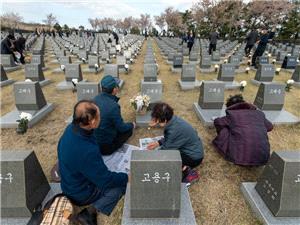
About 30,000 islanders -- 10% of Jeju"s population at that time -- were killed during the Jeju Massacre of 1947 to 1954, which is widely referred to as the Jeju 4.3 Incident, or simply as Jeju 4.3, in Korean.
In its statement Wednesday, the ministry said Park was issued the national merit certificate on Nov. 4 following an application submitted by his bereaved family.
The national merit designation is a formal state honor, granted in the president"s name, that honors and commemorates an individual"s contributions and sacrifices to the nation.
The honor has been met with staunch opposition on the island.
The local government issued a statement Wednesday expressing its "deep regret" over the registration of Park as a national merit recipient, stating it will continue to work to establish "a historical record based on fact so that the truth of the Jeju 4.3 Incident and the honor of its victims are not undermined."
It said the province is "concerned" that it made the decision to confer the honor on Park without considering "the historical context of 4.3 could cause confusion and harm within the local community."
The Jeju government said that Park was given the honor for having been awarded a military medal decades ago, and that this current system for conferring awards harms the victims of the Jeju Massacre.
In response, the local government will install a sign at Park"s memorial on Monday that will include information about the massacre, including Park"s activities during the roughly 40 days he was on Jeju.
"The truth of 4.3 has been confirmed not through any particular viewpoint or political interpretation, but on the basis of the state"s official report and the accumulated body of research. Jeju Province will continue to faithfully convey the historical truth of 4.3 through fact-based explanations," Jeju Gov. Oh Young-hoon said in a statement.
"We will continue to take responsible action to ensure that the honor of the victims and their families is not damaged and that the truth is set right."
The ministry said it will work to prepare measures to ensure that similar issues do not occur in the future.
"Once again, we extend our sincere apologies to the Jeju 4.3 victims, their bereaved families and the people of Jeju," it said.
The apology came on the same day a court ruled that Tae Yong-ho, a former politician of the conservative People"s Power Party, had defamed the Jeju 4.3 victims and bereaved families by making statements.
In early 2023, controversy erupted on Jeju after Tae claimed the uprising of April 3, 1948, was initiated by North Korean founder Kim Il Sung and his communist party.
The official government investigation report said there is "no concrete evidence that the events were directed by the instructions of the headquarters of the South Korean Labor Party."
Following Tae"s comments, right-wing political organizations erected 80 banners around the island that advertised his remarks. The banners were promptly removed by local officials.
The court on Wednesday ordered Tae to compensate the complainant, the the Jeju 4.3 Bereaved Families Association.