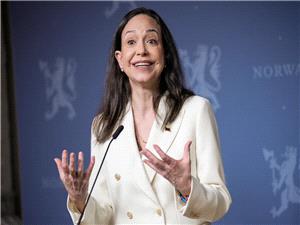
Arya News - Opposition leader Maria Corina Machado says Maduro’s presidency will end, aims for peaceful transition in Venezuela.
In her second public appearance after more than a year in hiding, Venezuelan opposition leader Maria Corina Machado has promised that, one way or another, the presidency of Nicolas Maduro will end.
Speaking to reporters in Oslo, Norway, on Friday, Machado added that she was still hopeful that a change in leadership in Venezuela would be peaceful.
“Maduro will leave power, whether it is negotiated or not negotiated,” Machado said in Spanish. “I am focused on an orderly and peaceful transition.”
Her latest statement comes as the administration of US President Donald Trump maintains its buildup of military forces in the Caribbean.
The Trump administration has repeatedly struck alleged drug smuggling boats in the region, in what experts say amounts to extrajudicial killings . The president has also, in recent days, repeatedly threatened to begin operations on Venezuelan territories, in what he has characterised as actions to stem illegal drug flows from the country.
Maduro has accused the Trump administration of seeking to topple his government. Some critics have accused the US of aiming to open up Venezuela’s vast oil reserves to US and Western companies.
Machado, who remains popular in the Latin American country but was barred from running in last year’s presidential election, has been seen by many as Washington’s favourite to replace Maduro.
The opposition has maintained that Machado’s replacement, Edmond Gonzalez, won the July polls by a landslide, with a group of independent election experts later legitimising their evidence. Maduro has continued to claim victory.
On Thursday, Machado emerged in Oslo, Norway, where she received the Nobel Peace Prize after evading a travel ban in her home country.
Praise for Trump’s pressure
The 58-year-old opposition leader has aligned herself closely with Trump and Venezuela hawks in the Republican Party.
She has praised several actions taken by the Trump administration to pressure Maduro, including the US seizure of a sanctioned oil tanker in the Caribbean earlier this week.
Machado called Trump’s actions “decisive” in weakening Maduro’s government.
She has been more circumspect on the prospect of military action on Venezuelan territory, saying only on Thursday that Venezuela “has already been invaded”.
“We have the Russian agents, we have the Iranian agents, we have terrorist groups such as Hezbollah, Hamas, operating freely in accordance with the regime. We have the Colombian guerrilla, the drug cartels,” she said.
On Friday, she predicted that Venezuela’s armed forces would comply with a transition of power.
“I have confidence that the immense majority of the Venezuelan armed forces and the police are going, in the instant that the transition begins, to obey orders, guidelines, instructions from the superiors who will be designated by the civil authority duly elected by Venezuelans,” she said.
Experts have warned that any transition would need to be carefully negotiated with political and military officials to avoid an internal conflict.
Speaking at a briefing earlier this week, Francesca Emanuele, senior policy associate for Latin America at the Center for Economic and Policy Research (CEPR), noted that Maduro’s Chavismo ideology, named after former leader Hugo Chavez, remains a strong political force in Venezuela, while segments of the opposition are also staunchly opposed to US military interventions.
A deeply entrenched system of corruption and patronage will also make many military officials hesitant to change allegiances, she explained.
“The military won’t want to leave the government of Maduro if they don’t have amnesties, if there is no negotiation, so we [could] see a very horrible, devastating conflict in Venezuela that would spread in the region,” she said in reference to a possible US military intervention.
No indication of easing up
For its part, the Trump administration has shown little indication that it planned to alleviate pressure.
Speaking to reporters on Thursday, White House spokesperson Karoline Leavitt would not rule out future seizures of sanctioned vessels off Venezuela’s coast.
On Friday, Reuters news agency reported that Admiral Alvin Holsey, who leads US military forces in Latin America, would retire early.
Three US officials and two people familiar with the matter told the news agency that Holsey was forced out by US Secretary of Defense Pete Hegseth over frustrations with his response to the Pentagon’s increasingly aggressive strategy in the region.
Holsey has not publicly explained the reason for his retirement.
However, Republican lawmaker Representative Mike Rogers told Politico that the admiral told members of Congress in a closed-door briefing that it was unrelated to the operations under his command.