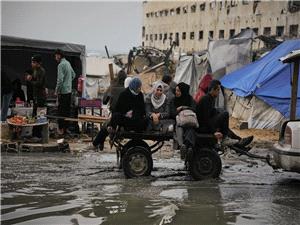
Arya News - Gaza’s residents face deadly winter storms as weakened, bombed-out homes collapse.
The humanitarian situation in the Gaza Strip deteriorated sharply late last week during Storm Byron, which brought heavy rainfall and strong winds.
Widely circulated video on social media showed Palestinian Civil Defence teams scrabbling through the rubble of fallen buildings, trying to rescue people trapped beneath.
But why did those homes fall? And what has the impact been on people in Gaza? Here’s what we know:
What is happening in Gaza?
Many damaged homes in Gaza collapsed during the recent storm, trapping people in their rubble.
At times, parts of buildings and walls fell onto nearby tents where displaced Palestinians were living, compounding the risks for civilians already enduring precarious conditions.
Thousands of Gaza families are sheltering in structurally compromised buildings, having lost their own homes during the war, with no safe alternatives available.
The heavy rainfall of Storm Byron turned these weakened structures into direct threats as floodwaters inundated tens of thousands of tents.
Why are these houses falling?
It’s not just the rain that caused the collapses, rather it is because two years of intense bombing during Israel’s genocidal war on Gaza have made these structures unstable.
In addition, Israel has imposed a siege on Gaza that prevents the entry of any building materials people can use to fix their homes.
Thousands of residential buildings were damaged by direct strikes, nearby bombardments and ground incursions, leaving cracks in columns and foundations, separation of load-bearing walls and partial roof collapses.
People with nowhere to go have little choice other than to shelter wherever they can, including in homes that are only partially standing.
Heavy rain exacerbates the damage. Water seeps into cracks, weakening foundations and columns while saturated soil erodes beneath buildings, increasing the risk of sudden collapses.
Overcrowding inside damaged homes further stresses weakened structures as multiple families are often forced to live together in a single house or floor.
In many cases, displaced residents pitch tents next to or even on top of the ruins of damaged buildings, exposing themselves to falling walls and concrete blocks during storms.
Displaced people often cannot leave, even when they know the risks. Often, they have no other option, or they see damaged homes as better shelter than deteriorating tents.
In late September, Gaza’s Government Media Office estimated that 93 percent of tents (about 125,000 out of 135,000) were no longer suitable for habitation.
How many people have been hurt or killed by these collapsing homes?
The recent storm killed 11 Palestinians in less than 24 hours and caused widespread structural damage.
According to the Government Media Office, 13 homes collapsed and 27,000 tents were flooded or swept away.
Civil Defence and Ministry of Health sources said the 11 victims were found dead under rubble in collapsed homes or in nearby tents. Another six were injured.
Fatalities included children, women and elderly people, and officials confirmed a baby girl died from extreme cold. Incidents were reported in Gaza City, northern Gaza, and central and southern areas of the Gaza Strip.
Collapses occurred in Gaza City’s Nassr neighbourhood, Shati refugee camp and Tal al-Hawa neighbourhood.
One man was killed when a wall collapsed in the Shati camp.
During the storm, the Civil Defence received more than 2,500 distress calls from displaced people.
Authorities warned that the death toll is likely to rise as further low-pressure systems and rainfall continue to cause homes to collapse.
Has there been any help for these impacted people?
Because of the conditions imposed by Israel, the emergency response has been limited.
Civil Defence teams struggled to evacuate those trapped under rubble because they face a shortage of heavy machinery, rescue equipment and fuel as well as flooded roads.
The Civil Defence has urged residents to get out of damaged homes during the storms.
Authorities stressed that the continuation of Israel’s blockade increases the likelihood of similar incidents during future storms.
Authorities have not been able to provide alternative shelters or habitable tents for unhoused families.
In some areas, aid has been limited to small distributions of blankets and basic relief items that are insufficient to meet the needs of Palestinians facing falling temperatures and widespread infrastructure damage.
Municipalities have been unable to carry out preventive drainage or repair work due to the destroyed infrastructure and a lack of resources, so t he people of Gaza remain vulnerable to future storms.
Is there anything that people in Gaza can do to stay safe?
Unfortunately, options are extremely limited or nonexistent.
Thousands of people are unable to relocate due to the absence of safe housing or shelters.
There are also restrictions on movement imposed by the “yellow line” demarcating the portion of Gaza under Israeli army control. People in at-risk areas cannot move to safer locations.
On top of that, people lack tools for structural reinforcement, waterproofing or heating.
People can take only minimal measures, such as moving children to more stable areas, using blankets or raising their belongings off the ground, but these do not prevent collapses or flooding.
UNRWA, the United Nations agency for Palestinian refugees, said the suffering could be reduced if humanitarian aid were allowed to enter Gaza without obstacles.
It said flooded streets and soaked tents are worsening already dire living conditions and increasing health risks.
Despite a ceasefire that began on October 10, conditions for Palestinians in Gaza have not improved due to Israel’s obstruction of aid, which violates the truce.