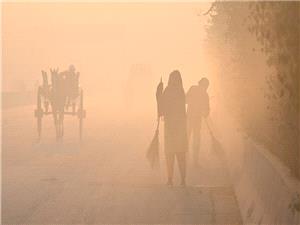
Arya News - The report also concludes that urban smog is overwhelmingly generated within Pakistan’s own airsheds.
ISLAMABAD – A new national assessment by the Pakistan Air Quality Initiative (PAQI) has found that local emission sources are the primary contributors to the hazardous air quality levels in Pakistan’s major cities. This emerged on Tuesday.
The PAQI is an independent research and advocacy organisation committed to addressing air pollution in Pakistan.
The report, Unveiling Pakistan’s Air Pollution: A National Landscape Report on Health Risks, Sources and Solutions , provides the country’s first multi-sectoral emissions inventories and concludes that urban smog is overwhelmingly generated within Pakistan’s own airsheds.
“Toxic air pollution reduces the life expectancy of the average Pakistani by 3.9 years,” the report states.
The report draws on satellite-derived aerosol datasets, chemical transport modelling and PAQI’s nationwide real-time monitoring network, the largest open-data air-quality system in Pakistan, to map the sources, scale, and health impacts of PM2.5 across the country’s largest cities.
PM2.5 is a cancer-causing microparticle small enough to enter the bloodstream. The World Health Organisation (WHO) established an annual average limit at 5 micrograms per cubic metre (µg/m³) and a 24-hour limit at 15 µg/m³.
The cities studied in the report include Karachi, Lahore, Islamabad, Rawalpindi and Peshawar, where the emission profiles identified for these cities are sharply different.
In Lahore, transport, industry and brick kilns are the dominant contributors to particulate pollution, while in Karachi, industry accounts for nearly half of PM2.5 emissions.
Emissions in the twin cities are primarily transport-driven, and Peshawar shows the highest per-capita exposure due to transit-trade activity and valley geography.
The report represents nearly a decade of work to build a transparent, evidence-based foundation for air quality governance in Pakistan.
The chapters situate the emissions inventory within a broader national conversation on constitutional rights, environmental justice, and institutional reform, with contributions from leading national voices such as former justice Syed Mansoor Ali Shah, Senator Sherry Rehman, Abid Suleiri and others.
“This inventory ends the era of speculation,” said Abid Omar, Founder of PAQI. “For the first time, Pakistan has a rigorous, data-driven map of where its pollution comes from. The science is clear: our crisis is overwhelmingly local and structural. We now have the evidence. What Pakistan needs next is implementation.”
Punjab Environment Protection Agency (EPA) spokesperson Sajid Bashir rejected PAQI’s report about local factors causing the pollution and told Dawn that the organisation did not have adequate data to develop it.
He said that the government was spending billions of rupees to control emissions and more than 80 per cent of industry in Lahore had adopted technologies to reduce pollution.
Bashir also questioned the report and noted that it did not have accurate data about light and heavy transport vehicles, motorcycles, rickshaws and brick kilns operating in the country. He termed traffic and brick kilns as key contributors to pollution.
The EPA spokesperson also said that PAQI should disclose its sources, the origin of its satellite data and images, and the laboratory where all the data were analysed.
“They should reveal their sources about the credibility of the report and question why authorities should comment on their report,” he stated.
“The government had taken measures and the smog crisis was addressed to a large extent. Continuous efforts are being carried out to improve the situation further.
Bashir added that the government had not closed educational institutions due to smog this year and said that the report was criticising their efforts.
According to a PAQI analysis released last week, Lahore experienced a significant reprieve from extreme smog conditions this November compared to the hazardous emergency of 2024.
Data for November 2025 confirms a dramatic 56 per cent reduction in daily peak pollution intensity. The maximum daily PM2.5 concentration plummeted to 237 µg/m³, a stark contrast to the severe peak of 539 µg/m³ recorded on November 14, 2024.
In October, Lahore was ranked the second most polluted city in the world in terms of air quality, according to global monitor IQAir.