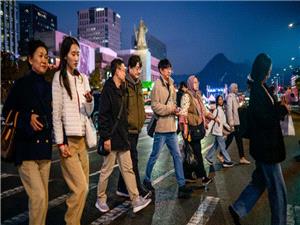
Arya News - Reports show that people in their twenties and thirties have an increasingly negative perception of regions outside of Seoul, Incheon and Gyeonggi Province, largely due to a widening wage gap.
SEOUL – Despite the government’s continued efforts to disperse population growth away from Seoul, a new survey suggests population centralization to the greater Seoul area is intensifying.
The sustained outflow of young people from regional areas to the capital region appears to be motivated by expectations of higher wages and better infrastructure. Reports show that people in their twenties and thirties have an increasingly negative perception of regions outside of Seoul, Incheon and Gyeonggi Province, largely due to a widening wage gap.
According to a report released Tuesday by research firm Leaders Index, net population inflows among people aged 20-39 in the past four years have become increasingly concentrated in Seoul and regions surrounding the capital.
Between 2022 and October 2025, Seoul alone recorded a net increase of about 77,500 people in this age group, more than double the increase seen in the previous four-year period ending in 2021, despite the city’s overall population continuing to decline.
Greater Seoul, which includes Incheon and Gyeonggi Province, recorded an accumulated net inflow of about 226,684 people from more distant regions.
By contrast, the Gyeongsang provinces, home to major manufacturing hubs, and Gwangju recorded respective net outflows of about 152,000 and 22,000 young people over the past four years.
Experts warn that the continued migration of young people to the Seoul metropolitan area will deepen economic and infrastructure decline in other provinces while intensifying congestion and public service strain in Greater Seoul.
Experts attribute the sustained outflow from established industrial regions to the stagnation of job structures and the widening gap in living and cultural infrastructure between Seoul and more remote provinces.
Among individuals aged 15-39, those who moved from regional areas to Seoul and surrounding provinces between 2022 and 2023 saw their average annual income rise by 5.57 million won ($3,800), or 22.8 percent, to 29.96 million won, according to a Ministry of Data and Statistics survey released earlier this month.
In contrast, individuals who moved from Greater Seoul to other provinces experienced an income increase of just 7.6 percent, reaching an average of 28.97 million won.
“Despite the presence of industrial bases in regional areas, there are fewer high-paying jobs outside the Seoul metropolitan area,” a government official said. “As a result, many young people are limited to non-regular employment or prolonged job seeking, prompting them to move to Seoul and nearby areas.”
The official added that the concentration of women-friendly workplaces in the Seoul metropolitan area also contributes to youth outmigration.
Women who moved from regional areas to Seoul and surrounding provinces recorded a 25.5 percent increase in income, while those who moved in the opposite direction saw an increase of just 0.8 percent.
“Except for some engineering positions, most jobs available to women here are accounting or general office work,” said a woman in her 30s surnamed Lee, who works in Ulsan after graduating from a local university.
“At my career stage, many jobs offer less than 2.5 million won a month and can easily be replaced by entry-level workers, leaving few opportunities for career recognition.”
Labor market analysts say the outflow of young people from regional areas has become structural, reinforced by deeply rooted perceptions of provincial disadvantage.
Avoiding jobs outside the Seoul metropolitan area is particularly pronounced among younger jobseekers. In a May survey conducted by employment information platform Catch, 63 percent of respondents said they had no intention of seeking employment outside the Seoul metropolitan area.
The main reasons cited for avoiding regional employment included weaker living and transportation infrastructure, as well as the concentration of major companies in and around Seoul.
Experts argue that subsidies alone will be insufficient to reverse the trend, calling instead for a two-track approach that simultaneously focuses on creating high-quality private-sector jobs and improving living conditions in regional areas.
“Only when regions offer an environment where people can realistically settle will wages rise, and living conditions such as transportation, education and health care improve,” said Kim Dae-jong, a business professor at Sejong University.
“Ultimately, perceptions of regional areas will change only when they are treated not as targets of support, but as spaces of investment opportunity.”