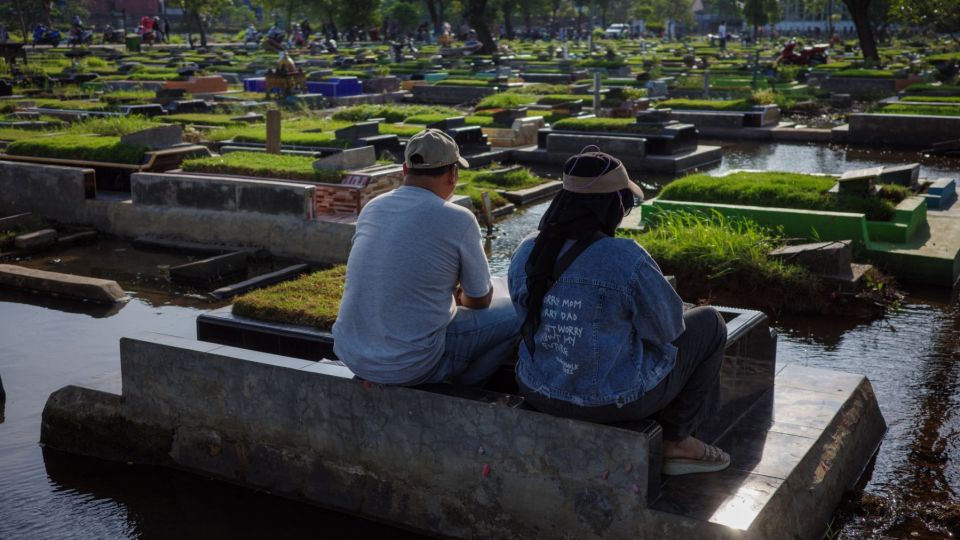
Arya News - The Indonesian capital is planning to revitalise and expand several public cemeteries at the expense of poor residents who have lived among the graves on city-owned land for decades.
JAKARTA – As Jakarta struggles to find places to bury its dead, the city administration is pushing a plan to evict hundreds of households from poor neighborhoods in West and East Jakarta to make way for plans to restore and expand public cemeteries (TPU).
The plan comes following a shortage of burial land in Jakarta, with at least 69 of the capital’s 80 TPU full. Some of the remaining 11 cemeteries are at over 80 percent capacity, leaving only 118,000 graves that may dwindle quickly in the next few years.
To solve the issue, the city administration is planning to relocate people who have been living near cemeteries for years to make way for new graves. Moving 280 families occupying the Rawa Bunga and Kebon Nanas TPU in East Jakarta, for example, may give enough room for 450 and 1,500 new graves, respectively.
In West Jakarta, where the municipality is strained by the limited availability of burial plots, the city administration is planning to expand the Pegadungan TPU in Kalideres district. To do this, authorities would need to evict at least 127 households occupying the 65-hectare Kampung Bilik neighborhood, located next to the already-full cemetery.
Kampung Bilik is home to mostly semipermanent buildings and bamboo houses owned by residents who do not hold land certificates, making them more vulnerable to eviction. The land is owned by the Jakarta Parks and Forestry Agency, according to an information board installed in the area.
Read also: Accommodating the dead: Jakarta faces grave shortage crisis
The Kamal subdistrict administration has announced to Kampung Bilik residents that the city is planning to expand and renovate Pegadungan, as parts of the land are reportedly occupied by the residents. The announcement was put in a letter dated Nov. 17 seen by The Jakarta Post on Monday.
Kamal Bilik residents were initially urged to clear the area by Dec. 2. But after multiple negotiations, the city authorities agreed to extend the deadline by March 28 next year, according to Muhammad Hasanudin, the head of community unit (RW) 07 that is to be evicted.
“The residents are all aware that they are occupying land that doesn’t belong to them,” he told the Post on Monday.
‘Not stray cats’
West Jakarta Parks Agency head Dirja Kusuma told state news agency Antara the city would relocate residents into a Rusun (low-cost apartment) but stopped short of revealing its location. He added only Jakarta ID card holders would be eligible for the apartment.
But the eviction plan has put the lives of the residents, such as Lilik Suharna, 65, who has been living in the area since the 1990s, in limbo.
While admitting it was inevitable that they would be relocated as they occupy a city-owned plot of land, he claimed not to have heard clear or sufficient information about the plan as well as the location and accessibility of the Rusun given that many residents are schoolchildren and small traders.
“Don’t shoo us away as if we’re stray cats,” Lilik said. “We need clarity and a guarantee about our future. After all, we’ve been living in this former idle land since decades ago.”
Read also: Poverty rate falls but urban struggles persist
Other residents shared similar frustration and confusion. One of them was Sairul Fahmi, who said the city administration had yet to communicate directly with the residents about the eviction.
“The government should have stood by us and explored alternative sites for the public cemetery,” he said.
Jakarta Parks and Forestry Agency head M. Fajar Sauri did not respond to the Post’s request for comment on the eviction plan.
Experts have warned the city’s prolonged cemetery crisis burdens the urban poor and increases the commercialization of burial plots in the capital.
Jakarta-based rights group Urban Poor Consortium (UPC) coordinator Gugun Muhammad acknowledged the critical condition of Jakarta’s public cemeteries, but asserted the issue should not be solved by sacrificing marginalized communities.
“Building a cemetery for the dead while displacing the living sounds so wrong to me,” Gugun said.
Authorities’ plan to deploy “a traditional way” through eviction reflects the top-down policymaking process that lacks meaningful public participation, he added.
Read also: Underprivileged millennials: Being young and poor in Jakarta
In a crowded Jakarta where land is scarce, large-scale evictions by authorities have marred development for years, with its trend showing little sign of receding.
In a new report published on Saturday, the Jakarta Legal Aid Foundation (LBH Jakarta) found at least 14 eviction cases across the city between January and October, mostly done by the state and triggered by land ownership issues.
Evictions throughout this year cleared at least 133 homes, displaced 338 households and led to the demolition of two small markets, the group added.