Arya News - Over 10 people murdered every day on average during the last 15 months.
DHAKA – A spate of killings, especially some targeted ones involving the use of firearms at crowded places in broad daylight, has stirred fresh concerns about the state of law and order as the country prepares for the national election.
Although Home Adviser Lt Gen (retd) Jahangir Alam Chowdhury insists there is “no risk” of deterioration before the February polls, crime analysts believe the election itself is one of the factors behind the disturbing trend.
Illegal firearms, weak policing, and reactivation of top criminals released after last year’s political changeover are mainly driving the killings, the analysts said.
They added that political rivalries, factional feuds, turf wars, and the use of gangs to assert influence ahead of the election are further fuelling targeted attacks and armed violence nationwide.
With the election schedule expected next week, candidates of major political parties have already begun campaigning informally. Violent protests and clashes over the parties’ choices have also been reported. Confrontations between activists of rival parties have occurred at some places.
Against this backdrop, a series of shocking attacks and killings in Dhaka, Chattogram, Khulna and elsewhere, has raised questions about public safety.
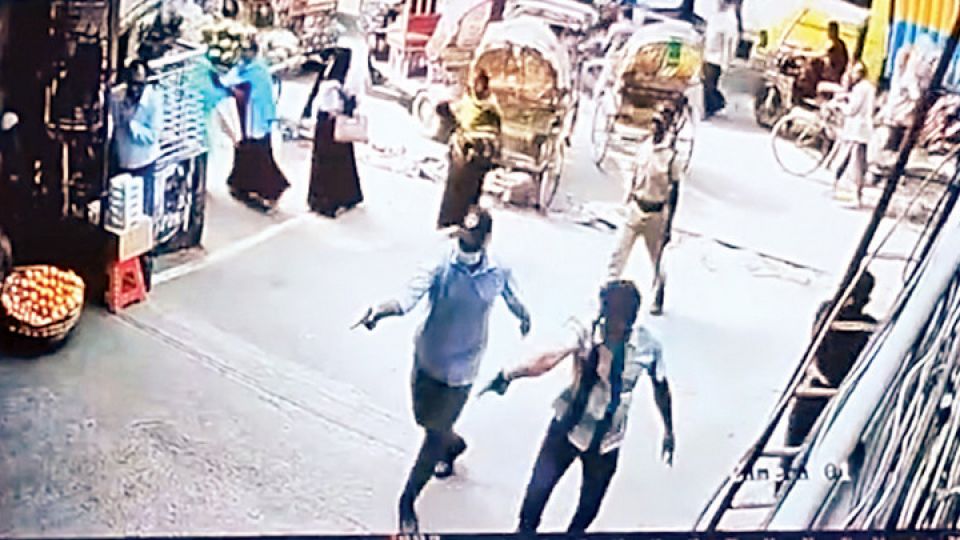
In one of these incidents, the assailants even shot and injured a rickshaw-puller for refusing to speed up as the attackers were fleeing after gunning down local Jubo Dal leader Golam Kibria in the capital’s Pallabi area on November 17. A CCTV footage of the attackers firing at Kibria multiple times inside a shop went viral on social media, sending a shockwave across the nation.
This week, two men linked to a criminal gang were gunned down outside the Khulna Metropolitan Sessions Judge’s Court. Days earlier, listed top criminal Tariq Saif Mamun was shot dead near Dhaka’s busiest court area, and earlier last month, Chattogram’s underworld figure Sarwar Hossain Babla was killed during a voter outreach event.
Law enforcement has struggled to regain footing since the fall of the Awami League government.
Human Rights Support Society (HRSS) reports at least 120 deaths in political violence between January and November. In November alone, it recorded 96 violent political incidents that left 12 people dead and around 874 injured, compared to October’s 64 incidents, 10 deaths, and 513 injuries.
The organisation notes sharp rises in intra- and inter-party clashes, turf battles, extortion, intimidation, and disputes linked to nominations for the 13th national election.
Police Headquarters data also paints a grim picture. Over the past 15 months, at least 4,809 murder cases were filed nationwide, including 3,236 in the first 10 months of 2025, up from 3,029 in the same period in 2024 and 2,563 in 2023.
In the 15-month period, Dhaka Metropolitan Police registered 551 murder cases. Many of these were tied to incidents from the August 5 changeover or earlier but filed only recently.
Data gathered by the Centre for Governance Studies (CGS) showed that the monthly average of murder cases fell to 322 in the first half of 2025, from 343 in the same period last year, though still far higher than the averages of 252 in 2023, 260 in 2022, and 268 in 2021.
Police Headquarters data shows on an average 325 murder cases were filed every month from July to October this year, compared to 261 in 2023. Last year’s average, however, spiked to 374 due to killings during the uprising. In August 2024 alone, 626 murder cases were filed. Cases over some of the murders that occurred during that period were also filed in 2025.
Adviser Jahangir on November 23 said there is “no risk” of law-and-order deterioration ahead of the national election, adding that the overall security environment is steadily improving.
“As the election approaches, the number of rallies and processions by different political parties will naturally increase. When we assumed office, the situation had already begun to deteriorate. Over the past year and a half, our efforts have helped bring significant improvements,” he said.
RISING GUN VIOLENCE
A CGS analysis shows a 30 percent rise in firearms-related offences, with over 150 incidents reported every month on an average until June.
Compounding the crisis, more than 1,300 firearms looted from police stations during the July uprising remain missing, many believed to be fuelling the recent surge in violent crime.
Although the government has announced rewards for information regarding the stolen arms, progress has been minimal.
Gun violence was shocking in November.
On November 30 in Khulna, Fazle Rabbi Rajon, 35, and Hasib Hawlader, 31, were shot dead outside the Metropolitan Sessions Judge’s Court.
On November 2, Tuhin Dewan, 22, was shot dead in Munshiganj amid a feud between two BNP groups. Arif Mir, 35, was killed eight days later in a clash linked to the same dispute, while injured Raihan Khan, 22, died on November 11.
That same day in Khulna’s Arongghata, teacher Imdadul Haque, 55, was shot dead near the BNP office.
On November 15 in Lakshmipur, ward BNP general secretary Abul Kalam was hacked and shot dead, with his wife accusing a Chhatra Dal activist.
On November 27 in Brahmanbaria, former Chhatra Dal leader Saddam Hossain, 35, was taken from his home at midnight and shot dead.
On November 5 in Chattogram, a known criminal Sarwar Hossain Babla, 43, was killed during a shooting at a campaign event for BNP’s candidate hopeful Ershad Ullah. Police in the port city linked Babla’s murder to clashes between rival factions vying for territorial control.
On November 13 in Chattogram’s Rangunia, Shramik Dal leader Abdul Mannan was shot dead.
On November 17 in Dhaka’s Mirpur, assailants entered a shop and shot dead Golam Kibria, 47, member secretary of Pallabi Thana Jubo Dal.
The violence followed multiple killings tied to political or local rivalries reported across the country in October, many involving firearms.
Just as December began, an auto-rickshaw driver, Pappu Sheikh, 26, was shot dead in Dhaka’s Jurain area, reportedly over previous enmity.
Speaking to this newspaper recently, criminologist Omar Faruk said every citizen “is now living with a sense of insecurity”.
With the election nearing, tensions will likely deepen as political groups may deploy released underworld criminals to display strength, conduct armed shows of force, and intimidate rivals, said Faruk, professor of criminology and police science at Mawlana Bhashani Science and Technology University.
He urged the government and police to re-arrest identified criminals and recover illegal firearms through focused operations.
“Otherwise, the upcoming election is unlikely to be peaceful or fair, and incidents of killing and violent crime may rise sharply,” he warned.
Security analyst Maj Gen (retd) ANM Muniruzzaman, president of the Bangladesh Institute of Peace and Security Studies, echoed the concern, saying that police presence and effectiveness remain below expectations.
“The political leadership at the home ministry, along with senior police officers, must take the necessary steps to boost the force’s morale so that they can operate more effectively and efficiently,” he said.
Contacted last night, Bangladesh Police spokesperson AHM Sahadat Hossaine told The Daily Star that ahead of the election, police are working with more confidence than they had in the months after the July uprising.
About preventing targeted killings, he cited difficulty in anticipating such incidents.
“What we often observe is that political rivalries and personal grudges operate at an individual or group level. And at that level, it is difficult to detect or prevent such incidents,” he said.
“But we act when there are some signs. For example, when a criminal is released from jail, we place them under watch through our intelligence units. If something occurs, police can step in early or take immediate legal action,” he said.